 0

You're sitting at mile 20. Four things happen at once.
A runner stops moving in the middle of a 100 miler in a spot with no reception. The last athlete just cleared the crossing on Oak Street, and the city is waiting on the call to reopen. A photographer texts asking about how far from the finish the lead woman is. The back-of-pack runner just made a wrong turn.
Four decisions. Sixty seconds.
Every one of those decisions depends on knowing where runners are right now, not where they were ten minutes ago.
What Traditional Splits Can't See
In endurance racing, a split is a results-table number. The 5K mark. The halfway point. The number a runner finds in their email an hour after crossing the finish line.
Useful for recaps. Worthless at mile 20 when making a decision.
Race directors will say they have splits today. They do, the way a city has a street atlas from 2009. Records of where things were. Not a map of where anything is.
Sparse checkpoints produce exactly that: a trail of past positions. The data tells directors where runners were, not where they are. The not-moving runner? Nobody knows how long she's been stopped.
Race directors need eyes on each runner. They need more splits.
What Changes When Checkpoints Are Dense
With enough checkpoints on course, splits stop being a post-race artifact. They become a live view of the race in motion.
Go back to those four decisions.
The photographer needs a position on the lead woman. With dense checkpoints feeding a live map, that position is current to the tenth of a mile. She's 0.4 miles out. Not estimated. Known.
The not moving runner: location confirmed. Medical has an exact position and are on their way.
Oak Street reopening. The city is waiting. The race director opens a field distribution chart showing every participant's position across the course, updated in real time. The last cluster has cleared. The officer gets a specific call, not a calculation.
Multiple threads. One view. All from the same splits that used to only show up in the results email.
The Tool Behind the View
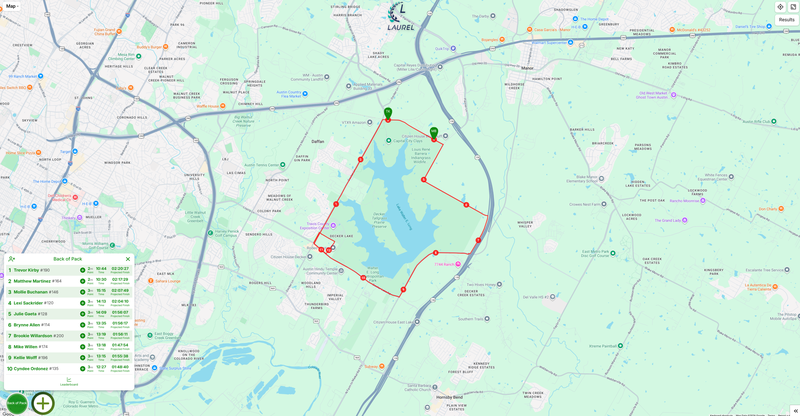
Laurel's race director dashboard shows every participant's position on course, filterable by back of pack, not moving, and leaderboards. The checkpoints feeding that view are about the size of an iPhone, which makes dense deployment a setup decision, not a logistical problem.
At a recent race this Spring, a late starter drifted behind the course cleanup crew. The race director saw the position, picked up the phone, and told her exactly where to turn to get back on course.
No new data category is required. Only more of the one race directors already have. Dense enough, and splits stop being a record. They become a live map.
The Category Shift
With traditional timing, race directors manage by estimate, radio, and educated guessing. The data arriving describes a race that has already moved on.
More split checkpoints close that gap. The call gets made before the city has to ask twice. The runner gets found before the situation gets worse. The answer is specific enough that every person waiting on it can act.
Mile 20 will always be unpredictable. But a runner's location shouldn't be. When the data is live, the delay disappears, and everyone waiting on an answer can act.